

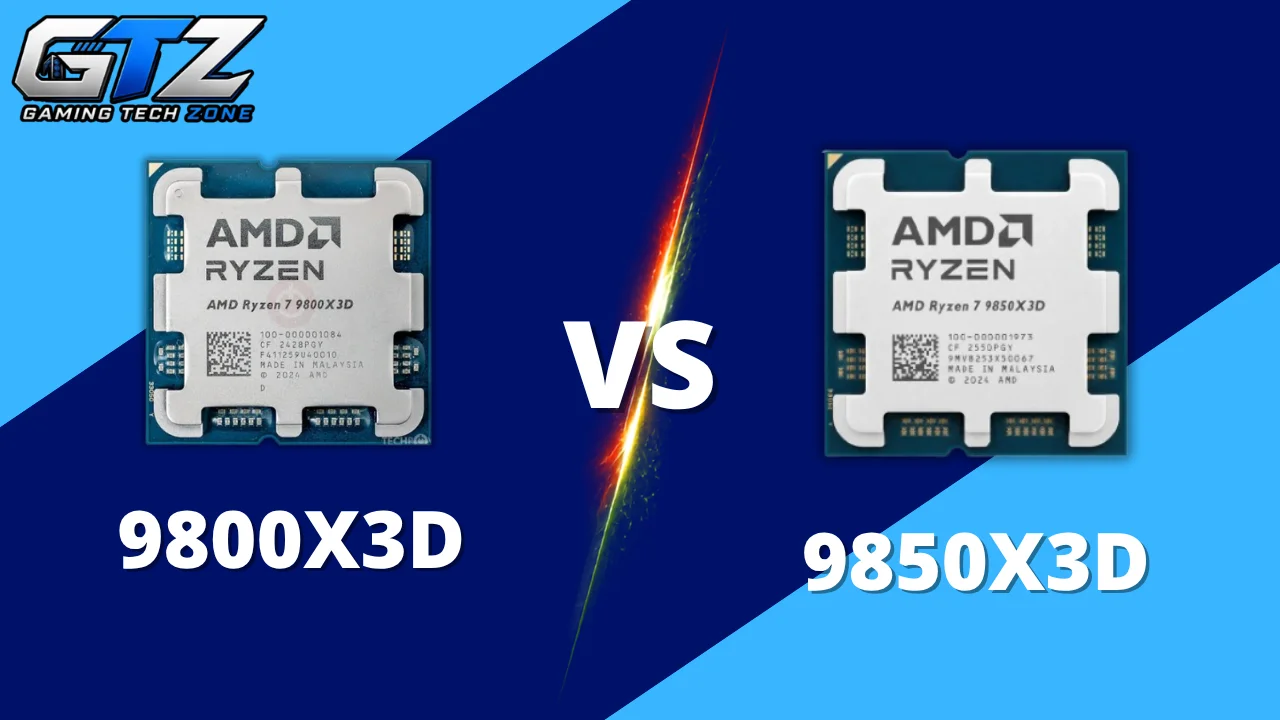
So you’re staring at two AMD listings that look almost identical, wondering why one costs $20 to $50 more than the other and whether that’s an actual upgrade or just a fresh coat of marketing on a chip you can already buy cheaper.
I ran into that exact wall myself. I’d already built around the 9800X3D when the 9850X3D showed up, and the spec sheet barely helped: same cores, same cache, same socket, just a bigger number on the boost clock.
So I dug through every independent benchmark I could find on gaming, power draw, and productivity, and checked it against what I’m actually getting out of my own 9800X3D, to settle the 9800x3d vs 9850x3d question for real instead of just repeating AMD’s slide deck.
Key Features
Before getting into the numbers, here’s what both chips actually have in common, and where they split:
- Both are 8-core, 16-thread Zen 5 chips built on AMD’s AM5 platform, so neither one changes your motherboard or memory requirements
- Both use AMD’s second-generation 3D V-Cache, which sits the cache die underneath the cores instead of on top — this is why both chips run cooler and clock higher than the older 7800X3D
- The 9850X3D’s only real change is a 400 MHz higher boost clock (5.6 GHz vs. 5.2 GHz)—same core count, same cache size, same TDP rating
- Neither chip ships with a cooler in the box, and AMD recommends at least a 240–280 mm liquid cooler for either one
My Experience with the Ryzen 7 9800X3D
I’m running the Ryzen 7 9800X3D with an EVGA RTX 3080 on a 1080p 200Hz monitor, paired with an MSI X670 motherboard and Cougar 850W PSU. It’s easily the best gaming performance I’ve experienced from a build, especially in GTA V (FiveM), Valorant, and Resident Evil Requiem.
Valorant is where the 9800X3D really shines. As a CPU-bound esports game, it benefits from the chip’s 3D V-Cache, delivering high FPS and more consistent frame times. On a 200Hz monitor, that smoothness is more noticeable than simply chasing higher FPS numbers.
GTA V tells a different story. With an RTX 3080, the GPU can become the limiting factor at 1080p, so the 9800X3D doesn’t get much room to show its advantage.
That’s worth knowing before buying: its biggest gains come in CPU-heavy, high-refresh games. Overclocking headroom is also modest, with PBO typically delivering only small, single-digit gaming gains.
What Is the AMD Ryzen 7 9800X3D and 9850X3D?
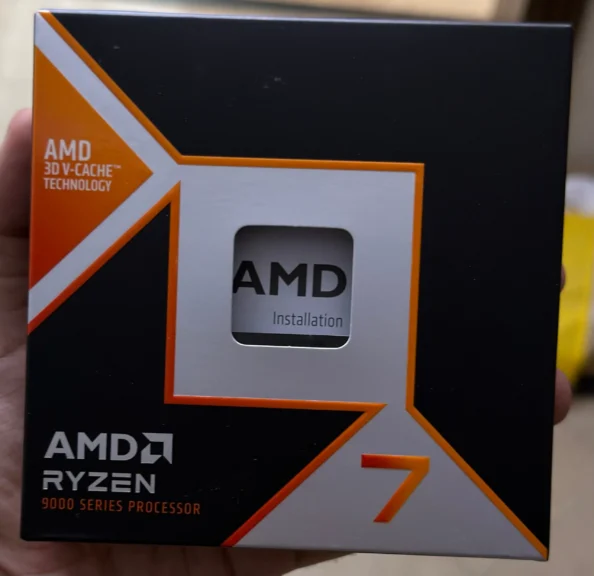
Ryzen 7 9800X3D:
The 9800X3D is AMD’s 2024 gaming flagship, an 8-core, 16-thread Zen 5 chip that launched in November 2024 at $479 and has held the “best gaming CPU” title for most of the time since. It pairs a 4.7 GHz base clock with a 5.2 GHz boost clock and 96MB of stacked 3D V-Cache, and it’s still widely available today.
Best for: builders who want top-tier gaming performance without paying a premium for a few extra percentage points.
Ryzen 7 9850X3D:
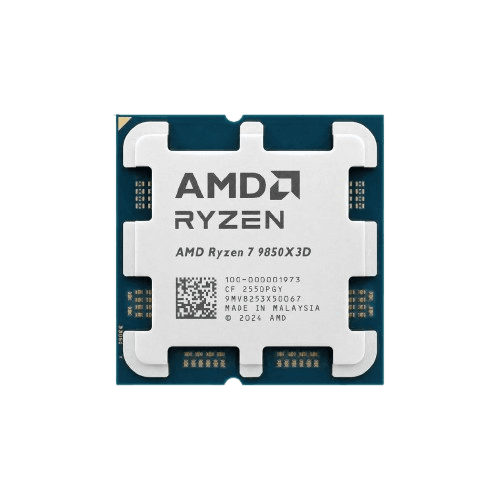
The 9850X3D is AMD’s January 2026 mid-cycle refresh of the same chip. It’s not a new architecture, it’s a better-binned version of the 9800X3D with a 5.6 GHz boost clock instead of 5.2 GHz. Everything else (cores, threads, cache, TDP, socket) stays identical.
Best for: new-build buyers who want the highest stock clock speed available in an 8-core X3D chip and don’t mind paying a small premium for it.
What is the Price of 9800x3d and 9850x3d?
- Ryzen 7 9800X3D: Launched at $479 typically around $430–$470.
- Ryzen 7 9850X3D: Launched at $499.
- Price difference: Around $20–$70, depending on the 9800X3D’s current retail price.
- Better value: 9800X3D, since the 9850X3D delivers only around 3–4% more gaming performance.
What Are the Specifications of the 9800X3D and 9850X3D?
| Specs | Ryzen 7 9800X3D | Ryzen 7 9850X3D |
|---|---|---|
| Architecture | Zen 5 (Granite Ridge) | Zen 5 (Granite Ridge) |
| Fabrication process | TSMC 4nm | TSMC 4nm |
| Cores / Threads | 8 / 16 | 8 / 16 |
| Base clock | 4.7 GHz | 4.7 GHz |
| Boost clock | 5.2 GHz | 5.6 GHz |
| L3 cache (3D V-Cache) | 96MB | 96MB |
| Total cache (L2+L3) | 104MB | 104MB |
| TDP / PPT | 120W / 162W | 120W / 162W |
| Socket | AM5 | AM5 |
| Memory support | DDR5-5600, up to 192GB | DDR5-5600, up to 192GB |
| Integrated graphics | Yes (Radeon) | Yes (Radeon) |
| Launch date | November 7, 2024 | January 29, 2026 |
| Launch MSRP | $479 | $499 |
How Many Cores and How Fast Are They?
Both chips run the exact same 8-core, 16-thread configuration, so neither one gives you more parallel processing power than the other. The only number that actually changes is the boost clock — 5.2 GHz on the 9800X3D versus 5.6 GHz on the 9850X3D.
In independent testing, that 400 MHz spec-sheet gap usually shows up as closer to 150–200 MHz in real, sustained gaming clocks, because both chips run into similar power and thermal limits before hitting their absolute ceiling.
How Much Cache Do You Get?
This is the part that actually makes both chips fast gaming CPUs. AMD’s second-generation 3D V-Cache places the 64MB cache die underneath the core complex rather than stacking it on top, which was the design used on the older 7800X3D and 5800X3D.
That change resolved a lot of the thermal headroom problems those older chips had, letting both the 9800X3D and 9850X3D clock significantly higher without cooking themselves.
How Much Power Do They Use?
- AMD rates both CPUs at a 120W TDP with a 162W PPT limit.
- These figures are default power targets, not guaranteed real-world power consumption.
- Independent testing shows the 9850X3D can draw noticeably more power than its clock-speed advantage might suggest.
- The higher power draw is the main trade-off for its extra performance, which is covered in the power consumption section below.
What Socket & Memory Support Do They Use?
- Both CPUs work with AM5 motherboards with a sufficiently recent BIOS.
- Both officially support DDR5-5600 memory.
- Both support up to 192GB of RAM across four DIMM slots.
- Neither CPU supports DDR4 memory.
- Upgrading from AM4 to either chip requires a full platform change, including a new motherboard and DDR5 memory.
What Is the Difference Between the 9800X3D and 9850X3D?
Across a 16-game average from Tom’s Hardware, the 9850X3D scored about 211 FPS versus roughly 205 FPS on the 9800X3D, a 3.2% gaming lead. GamersNexus found a similar pattern, describing the 9850X3D as “at best” 4% faster and often statistically identical, depending on the title. The gap is real, but it’s not something most people will notice while actually playing.
What’s the Power Consumption Difference?
This is where the two chips actually separate. Tom’s Hardware measured the 9850X3D drawing around 106W during gaming versus 81W for the 9800X3D — roughly 30% more power for about 3% more performance.
GamersNexus saw a similar trend under all-core production loads, with the 9850X3D pulling about 20W more at the socket. That power difference also shows up as heat: GamersNexus recorded the 9850X3D running 7–9°C warmer than the 9800X3D under the same cooling.
What Motherboard Do They Use?
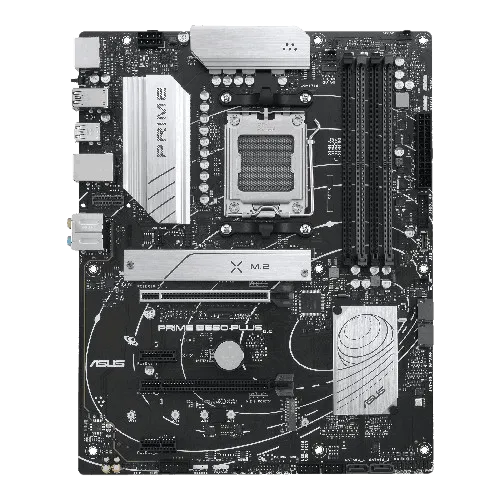
Both chips use the same AM5 socket, so any motherboard that supports Ryzen 9000-series X3D chips will physically accept either one.
The catch is BIOS support: because the 9850X3D launched over a year after the 9800X3D, older boards need an updated AGESA BIOS before they’ll recognize it, and some early boards required a BIOS Flashback update just to boot.
Do Both Chips Share the Same Architecture?
There’s no major architectural difference between the two CPUs. Both use the same Zen 5 Granite Ridge architecture, 4nm process, and second-generation 3D V-Cache design.
The 9850X3D is essentially a higher-binned version of the same silicon, with higher boost clocks delivering extra performance. In other words, it’s more like an “XT” refresh than a genuinely new CPU.
Gaming Performance and Benchmarks
Here’s how the two chips compare in a real-world game test, at 1080p and high settings, since 1440p and 4K testing showed almost no measurable difference between them once the GPU starts doing more of the work.
| Games | 9800X3D (FPS) | CPU Usage | 9850X3D (FPS) | CPU Usage |
|---|---|---|---|---|
| Ghost of Tsushima | ~196 | ~31% | ~202 | ~32% |
| Cyberpunk 2077 | ~194 | ~60% | ~200 | ~60% |
| Stalker 2 | ~96 | ~45% | ~102 | ~45% |
| Starfield | ~155 | ~82% | ~156 | ~82% |
| Marvel’s Spider-Man 2 | ~96 | ~70% | ~97 | ~70% |
| Remnant 2 | ~165 | ~30% | ~175 | ~30% |
Tested Rig:
- CPU: AMD Ryzen 7 9800X3D / Ryzen 7 9850X3D
- GPU: GeForce RTX 5090 Founders Edition
- Motherboard: MSI PRO X870E-P WiFi
- Memory: Corsair Dominator Platinum 32GB (2×16GB) DDR5-6000 CL30-36-36-76
- Test Bench: Streacom BC1 open benchtable
- CPU Cooling: Custom water loop with MO-RA 360 radiator and EK-Quantum Velocity Full Nickel block
These gaming benchmarks are studied and derived from the Benchmarks For Gamers YouTube channel.
If you’re pairing either chip with anything below a high-end GPU like an RTX 3080 or 4080-class card, for example, expect the gap between these two CPUs to shrink even further, since your graphics card becomes the limiting factor well before the CPU does. That’s exactly the pattern I saw in my own testing with GTA V above.
Productivity Benchmarks
| Benchmark | Workload Type | 9850X3D vs 9800X3D |
|---|---|---|
| Cinebench 2024 (multi-core) | Multi-threaded | ~1% faster |
| 7-Zip Compression | Multi-threaded | ~3.4% faster |
| 7-Zip Decompression | Multi-threaded | ~3% faster |
| Blender (render) | Multi-threaded | Effectively tied |
| HandBrake x265 encoding | Multi-threaded | Effectively tied |
| Cinebench 2024 (single-core) | Single-threaded | ~7% faster |
| POV-Ray (single-thread) | Single-threaded | ~6.5% faster |
| Lame audio encoding | Single/lightly threaded | ~6% faster |
Sources For Productivity Benchmarks: Toms Hardware and Gamer Nexus.
Ryzen 7 9800X3D Pros & Cons
| Pros | Cons |
|---|---|
| $20–$50 cheaper depending on retailer | Lower stock boost clock (5.2 GHz) |
| Meaningfully lower power draw and heat | Slightly behind in lightly-threaded tasks at stock |
| Closes most of the gap with PBO enabled | The “older” of the two, on paper |
| Same 3D V-Cache gaming advantage as the 9850X3D | Wider price swings depending on retailer stock |
Ryzen 7 9850X3D Pros & Cons
| Pros | Cons |
|---|---|
| Fastest 8-core gaming CPU at stock settings | Draws roughly 20-30% more power for ~3% more FPS |
| Higher single-threaded and lightly-threaded performance | Runs noticeably warmer under sustained load |
| Slightly better 1% lows in some titles | Gains mostly vanish once the 9800X3D is overclocked |
| Simple drop-in upgrade for a fresh AM5 build | Not worth it if you already own a 9800X3D |
Which Chip Suits You?
Ryzen 7 9800X3D:
Go with the 9800X3D if you’re budget-conscious, care about power efficiency for mixed use (streaming, a home office rig that doubles as a gaming PC), or you’re comfortable spending five minutes in the BIOS enabling PBO, which closes most of the performance gap for free.
It’s also the smarter pick if you’re upgrading from an older chip like a 2700X and 7800X3D or an Intel part, since that jump will be significant regardless of which X3D chip you land on.
Ryzen 7 9850X3D:
Go with the 9850X3D if you’re building an entirely new system from scratch, efficiency isn’t a priority, and you want the highest stock gaming performance available in an 8-core chip without touching overclocking settings at all. The premium is small in absolute dollar terms on a full new build, even if it’s a poor value proposition on its own.
Intel:
Consider Intel’s Core Ultra 9 285K if you’re already committed to the Intel/Z890 ecosystem, need specific platform features AMD doesn’t offer, or your workload leans toward tasks where Intel’s core arrangement performs competitively.
For pure gaming frame rates, though, independent testing consistently favors both AMD X3D chips over Intel’s current flagship.
If you are still confused on which CPU you should pick, our guide to picking a CPU is worth reading.
What to Choose Besides the 9800X3D and 9850X3D?
If neither of these two feels like the right fit, there are a few other AM5 options worth a look:
- Ryzen 7 7800X3D: the previous-generation X3D chip, often available well under $400. It uses the same core count and a similar cache design, and in most games the real-world difference against the 9800X3D is smaller than the price gap suggests. It’s the strongest pure-value pick on this list.
- Ryzen 9 9950X3D: a 16-core, 32-thread chip with 144MB of total cache, priced around $675–$699. Worth it if you split your time between gaming and genuinely core-hungry work like video editing or 3D rendering, where the extra eight cores actually get used.
- Intel Core Ultra 9 285K: the closest Intel alternative. Independent reviews consistently place it behind both AMD X3D chips in gaming, though it remains a reasonable pick if you’re already invested in the Intel platform or prioritize workloads where Intel’s core count holds up better.
If your budget doesn’t stretch to any X3D chip right now, it’s worth checking GamingTechZone’s breakdown of whether the Ryzen 5 lineup is still good and the head-to-head on the Ryzen 5 7600X vs Ryzen 5 9600X; both are genuinely capable gaming chips at a fraction of the price.
Common Buying Mistakes
Before you check out, here are the mistakes that trip people up most often with this exact comparison:
- Expecting a noticeable frame-rate jump. The real-world gap between these two chips is 0–4% in most games, genuinely hard to feel during actual play, even if it shows up on a chart.
- Forgetting neither chip includes a cooler. Budget at least $80–$150 for a solid air cooler or 240mm+ AIO on top of the CPU price.
- Pairing either chip with a mid-range GPU and expecting big CPU gains. At 1440p or 4K with anything below a high-end card, your GPU becomes the bottleneck long before either CPU does.
- Skipping the BIOS check on an existing AM5 board. If you already own an AM5 motherboard, confirm it has the AGESA update needed for the 9850X3D before ordering some early boards needed a BIOS Flashback just to boot with it.
- Ignoring PBO on the 9800X3D. A well-binned 9800X3D with Precision Boost Overdrive enabled can close most of the gap with the 9850X3D for free.
- Chasing the newest chip out of habit rather than checking street prices. The 7800X3D, and sometimes even a discounted 9800X3D, can be the better buy depending on what’s actually in stock that week.
What Would I Recommend?
I’ve chosen the 9800X3D for my own build, because for me, the extra few FPS doesn’t matter enough to justify the price. Even with the budget to spare for the extra $50, I still wouldn’t pick the 9850X3D.
If you’re building a completely new gaming PC, I’d lean toward the 9800X3D too, but that’s not a universal answer, because everyone has different priorities. Some people genuinely value squeezing out every last frame, and some people value getting the most performance per dollar.
Figure out your play style and your budget, and choose based on that rather than which chip has the bigger number on the box. If you want a budget option which can give performance for the next 2 to 3 years read our guide Ryzen 5 7600x and Ryzen 7 8700G if you want a chip that doesn’t need a graphics card.
Gamers Also Ask About the 9800X3D and 9850X3D
Only if you’re building a brand-new PC and don’t plan to overclock. The 9850X3D is faster out of the box by 3–4% in most games, but it costs more and draws noticeably more power to get there.
The only meaningful spec difference is boost clock — 5.2 GHz versus 5.6 GHz. Cores, threads, cache, TDP, and architecture are all identical between the two chips.
No. If you already own a 9800X3D, there’s no realistic scenario where spending $400+ for a 3% average gaming improvement makes financial sense.
It runs a few degrees warmer and pulls more power under load, so a slightly more capable cooler is a good idea, but neither chip demands an unusual PSU upgrade beyond what any modern build already needs.
Yes. It remains an excellent gaming CPU on its own, and it’s usually available at a meaningful discount compared to both the 9850X3D and its launch price.
