

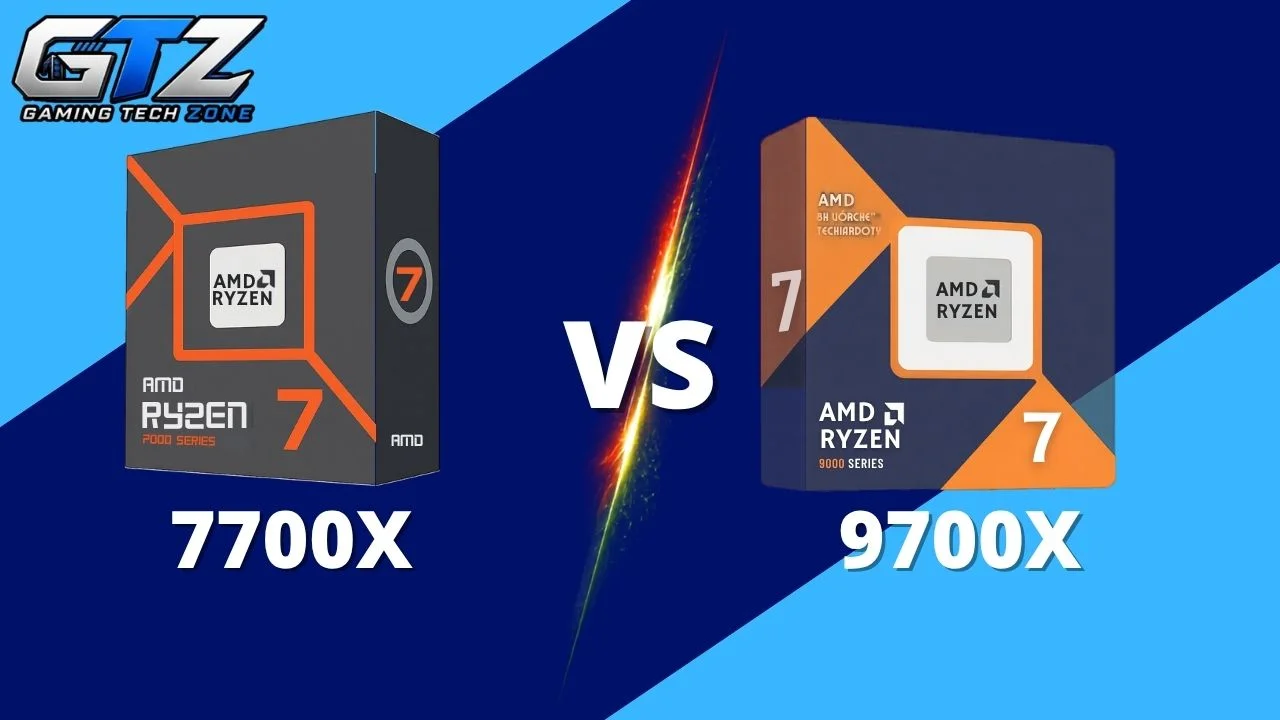
There is a reason the Ryzen 7 7700X and Ryzen 7 9700X are still being considered for gaming PCs in 2026. Both give 8 cores, 16 threads, AM5 compatibility, and enough CPU performance to handle demanding games without feeling outdated.
I can see the appeal of the 7700X, especially with its much lower price, while the 9700X makes a strong case with Zen 5 and dramatically lower power consumption.
So the real question is not which CPU is newer. It is whether the 9700X’s extra performance and efficiency are worth paying more for when the 7700X can still deliver very similar gaming results in some titles.
My Quick Picks
| Option | Ryzen 7 7700X | Ryzen 7 9700X |
|---|---|---|
| Best for | Best price-per-frame at 1080p | Best efficiency + slightly stronger 1440p |
| Street price (2026) | ~$250 | ~$320 |
| TDP | 105W | 65W |
What is Ryzen 7 and 9 Series Chips?
Both chips carry AMD’s “Ryzen 7” branding, but they belong to different generations of AMD’s desktop lineup, built on the same AM5 socket. The generation number in the model name (7000 vs 9000) tells you the architecture, not the core count, because both are 8-core, 16-thread parts.
What is 7700X?
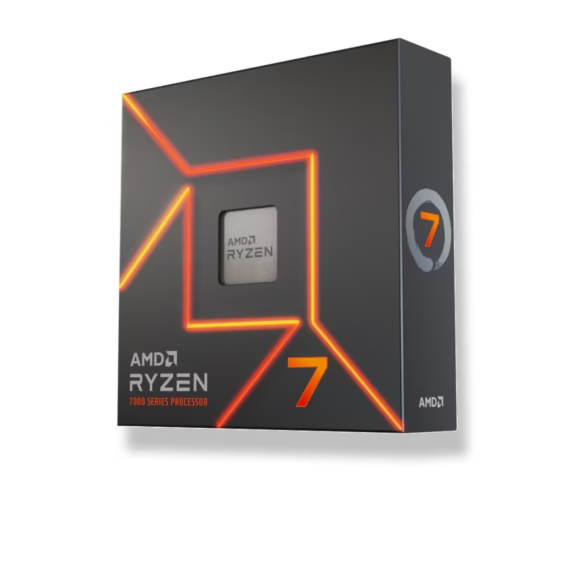
The Ryzen 7 7700X is AMD’s Zen 4 mid-range desktop chip, built on a 5nm process under the codename “Raphael.” It pairs 8 cores and 16 threads with a 4.5GHz base clock and boost speeds up to 5.4GHz, and it’s still one of the more common recommendations for a budget AM5 gaming build if you’re comparing it to a Ryzen 5 like the 7600X.
What is 9700x?
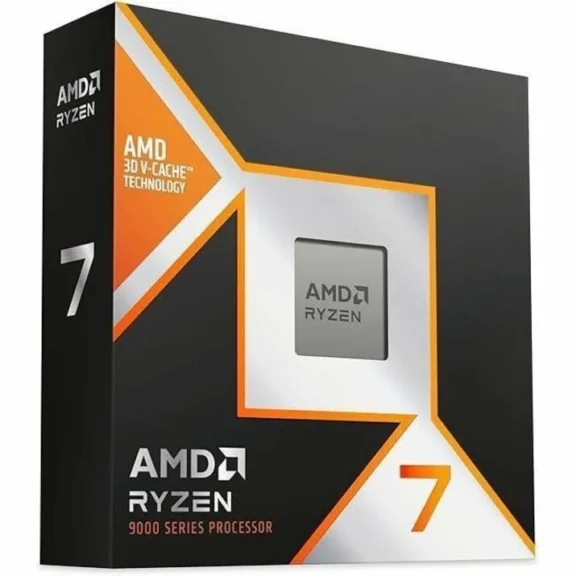
The Ryzen 7 9700X moves to AMD’s Zen 5 architecture on a 4nm process, codenamed “Granite Ridge.” Core and thread counts stay the same at 8/16, but AMD dropped the base clock to 3.8GHz while pushing boost up to 5.5GHz, and cut the TDP nearly in half in the process.
When Did 7700X and 9700X Released?
The Ryzen 7 7700X launched on September 27, 2022, alongside the rest of the Ryzen 7000 series, while the Ryzen 7 9700X arrived almost two years later on August 8, 2024, as part of the Ryzen 9000 launch.
What are the Prices of Ryzen 7 700x and 9700x?
The 7700X launched at $399 and now typically sells for around $250, while the 9700X launched at $359 and currently sits closer to $320 depending on the retailer.
- 7700X: $399 MSRP → ~$250 street price today
- 9700X: $359 MSRP → ~$280–$320 street price today
Please note: retail prices shift with sales and stock, so treat these as a snapshot rather than a fixed number.
The Difference of Specifications Between 7700X and 9700X
Side by side, the spec sheets look almost like a rounding error, with the same cores, same threads, same cache, but the clock behavior and power ceiling are where the two chips actually separate.
| Spec | Ryzen 7 7700X | Ryzen 7 9700X |
|---|---|---|
| Architecture | Zen 4 (Raphael) | Zen 5 (Granite Ridge) |
| Process node | 5nm (TSMC) | 4nm (TSMC) |
| Cores / Threads | 8 / 16 | 8 / 16 |
| Base clock | 4.5 GHz | 3.8 GHz |
| Boost clock | Up to 5.4 GHz | Up to 5.5 GHz |
| L2 + L3 cache | 8MB + 32MB | 8MB + 32MB |
| TDP | 105W | 65W |
| Socket | AM5 | AM5 |
| Memory support | DDR5-5200, up to 128GB | DDR5-5600, up to 192GB |
| PCIe | 5.0 | 5.0 |
| Integrated graphics | AMD Radeon Graphics | AMD Radeon Graphics |
Both chips support PCIe 5.0, so neither one will bottleneck a modern PCIe 5.0 SSD or GPU, that part of the platform is a non-issue either way.
Which Ryzen 7 is Better in Overall Performance?
Based on PassMark’s CPUBenchmark.net database, the Ryzen 7 9700X posts a CPU Mark of roughly 36,951 against the 7700X’s 35,486, only about 4% higher in raw multi-core throughput, but it pulls ahead by around 11% in single-thread performance, per the same benchmark database.
- Multi-core (CPU Mark): 9700X wins by ~4%
- Single-thread: 9700X wins by ~11%
- Value (CPU Mark per dollar): 7700X actually wins here, since its lower street price offsets its slightly lower raw score
- Power draw: 7700X uses roughly 47% more power under sustained load, according to the same PassMark comparison
Overall performance winner: The Ryzen 7 9700X, mainly on single-thread strength and efficiency, but the 7700X remains the better raw value pick if you’re purely chasing CPU Mark per dollar.
Which Ryzen 7 Series Chip is Better For Gaming?
Raw benchmark scores don’t always translate directly into frame rates, so here’s how the two chips actually perform across three genuinely different types of games. An open-world RPG, an action title, and a demanding open-world shooter.
Gaming Comparison
| Game | Resolution | 7700X | 9700X | Winner |
|---|---|---|---|---|
| Hogwarts Legacy | 1080p | ~60 | ~60 | Tie |
| Hogwarts Legacy | 1440p | ~55 | ~66 | 9700X |
| GOW Ragnarök | 1080p | ~220 | ~260 | 9700X |
| GOW Ragnarök | 1440p | ~220 | ~230 | 9700X |
| Cyberpunk 2077 | 1080p | ~170 | ~170 | Tie |
| Cyberpunk 2077 | 1440p | ~160 | ~170 | 9700X |
Gaming winner: The Ryzen 7 9700X, and the gap is largest in GOW Ragnarök at 1080p, where it’s pulling roughly 18% more frames than the 7700X.
Hogwarts Legacy and Cyberpunk 2077 stay close at 1080p, which lines up with what you’d expect once a game becomes GPU-bound rather than CPU-bound at that resolution.
Who Should Choose Which CPU?
Neither chip is a bad buy in 2026, this really comes down to what you already own and how much of a premium you’re willing to pay for the newer architecture.
If you want a broader framework before deciding, my guide to picking a CPU walks through the same trade-offs in more general terms.
The 7700X:
Budget-focused builders and anyone upgrading from an older platform who wants the lowest entry price into AM5.
- You’re building a 1080p-focused gaming PC and want the lowest cost-per-frame
- You’re upgrading from something much older, like a Ryzen 5 2600X, and just want a clear generational jump without spending extra on the newest silicon
- You already have a case and cooler solution that can comfortably handle a 105W chip
The Ryzen 7 7700X is better and my recommendation if someone has a mid-budget and is choosing the 5700X or 3700X.
The 9700X:
Builders who want lower power draw and slightly better 1440p performance and don’t mind paying roughly $60–$75 more.
- You’re pairing the CPU with a stronger GPU and gaming at 1440p or higher
- You want a quieter, cooler-running system without stepping up to a bulky cooler
- You’re building fresh and would rather buy the newer architecture while it’s still current
Alternative Option
AMD:
- Ryzen 5 7600X (Budget Alternative)
- Ryzen 7 9800X3D
- Ryzen 7 9850 X3D
- Ryzen 7 5700X
- Ryzen 7 8700G (If you want a integrated GPU)
Intel:
- Core Ultra 5 245K
- Ultra 7 265K
If you are deciding to go with the latest components, my 9800X3D vs 9850X3D guide is worth reading.
Example Gaming PC Build For Each CPU
These two example builds show roughly how each chip’s power draw and price point change the rest of the parts list.
Build 1: Ryzen 7 7700X (budget 1080p build)
- CPU: AMD Ryzen 7 7700X
- Cooler: Mid-range tower air cooler (105W needs decent airflow)
- Motherboard: B650 AM5 board
- RAM: 32GB DDR5-5200
- GPU: RTX 4060 or RX 7600 (worth comparing AMD vs Nvidia before you pick a side here)
- Storage: 1TB NVMe SSD
- PSU: 650W 80+ Gold
Build 2: Ryzen 7 9700X (efficiency-focused 1440p build)
- CPU: AMD Ryzen 7 9700X
- Cooler: 240mm AIO or high-end air cooler (65W leaves headroom)
- Motherboard: X670 board or a cheaper B650
- RAM: 32GB DDR5-5600 or 6000
- GPU: RTX 4070 or RX 7700 XT
- Storage: 1TB PCIe 5.0 NVMe SSD
- PSU: A well-built 850W unit like Cougar’s 850W PSU gives you headroom if you upgrade the GPU later
Which One Would I Recommend?
If I were spending my own money on a fresh AM5 build today, I’d lean toward the Ryzen 7 9700X because the lower power draw means less heat, a quieter cooler, and a bit more headroom in the 1440p games I actually care about, and the price gap over the 7700X isn’t large enough to change that math for most people.
That said, the 7700X isn’t a bad buy at all. If you’re strictly gaming at 1080p or light 1440p, watching every dollar, or already have a case and cooler that suit a 105W chip, it still gets you nearly identical frame rates in several titles for meaningfully less money.
Either way, you’re buying into a socket AMD has kept alive for years, so whichever one you pick now, you’re not locking yourself out of upgrading later.
