

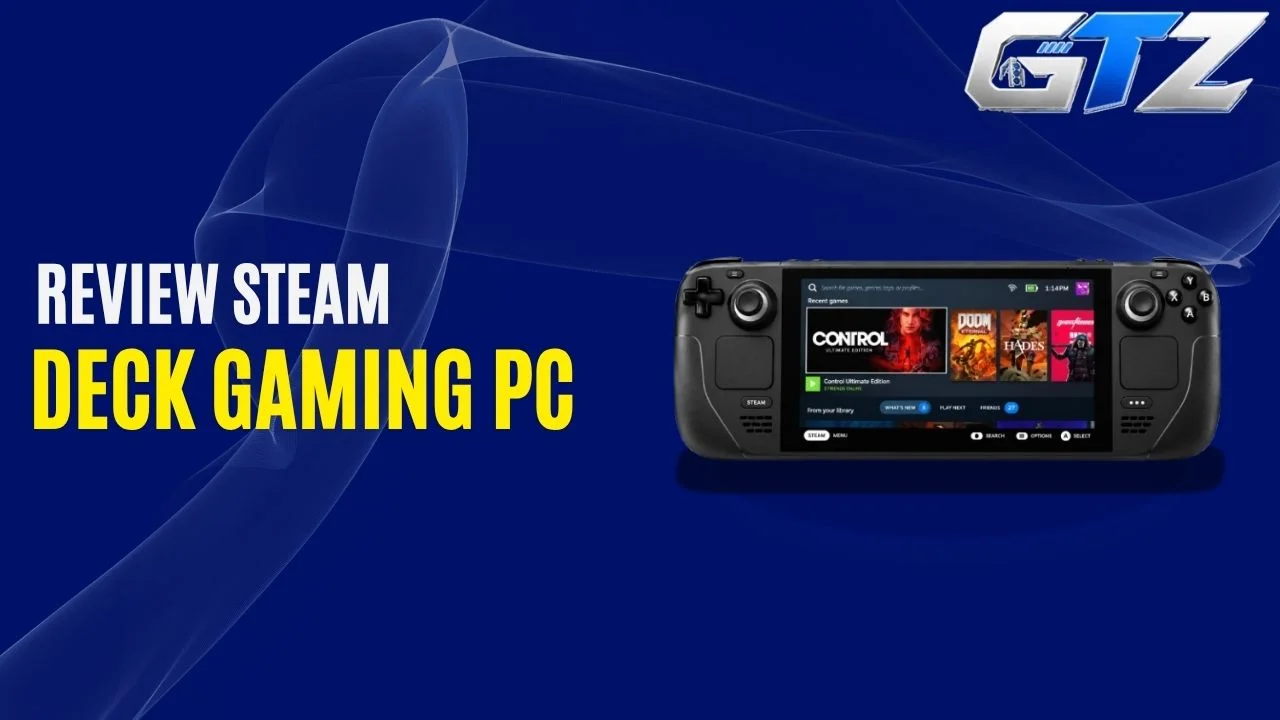
I’ve had plenty of nights when I wanted to play something but honestly didn’t feel like sitting at my gaming PC.
I wanted to take a game to the couch, play comfortably in bed, or simply pick up a device and start playing without setting anything up. That is where the Steam Deck caught my attention.
It puts your Steam library into a handheld that feels surprisingly natural to use. But after spending time researching and reading its reviews, I found that the experience depends heavily on the games you play.
In this guide, I’ll explain what the Steam Deck is like in 2026, how it performs, what it costs, and whether it’s still worth buying.
My Quick Review
The Steam Deck OLED is comfortable, convenient, and genuinely fun for story-driven and less demanding games, and SteamOS has matured into a smooth, console-like experience.
Where it struggles is raw power. Most modern AAA games run at 720p and 1080p around 30 FPS with visibly softer textures. If you already own a strong gaming PC, treat the Deck as a couch/travel companion, not a replacement.
What is a Steam Deck Gaming PC?
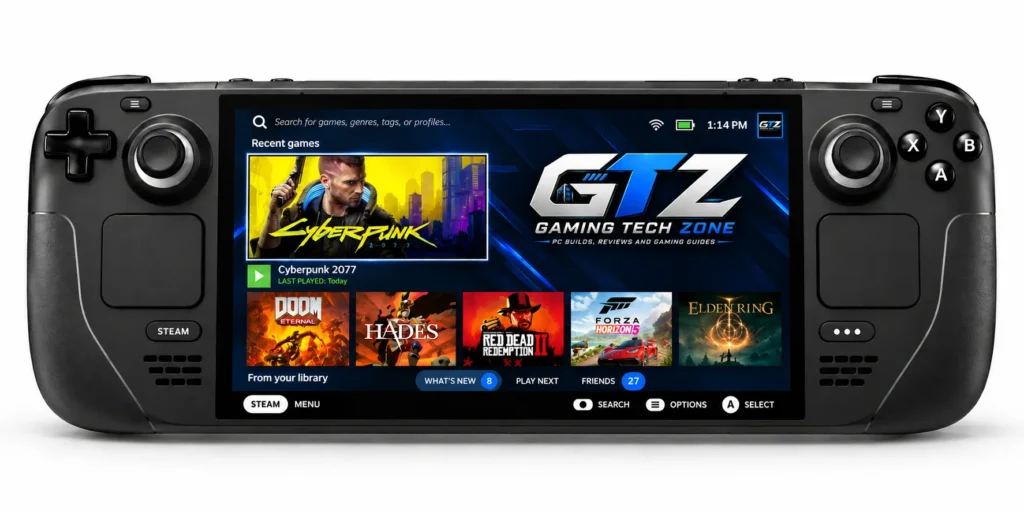
The Steam Deck is a handheld gaming PC built by Valve that runs SteamOS and plays most of your existing Steam library directly on a built-in screen, with the option to dock it to a TV or monitor. It’s part console, part PC, designed to let you take PC gaming anywhere.
When did Steam Deck Launch?
The original Steam Deck (LCD model) launched in February 2022, and Valve followed it up with the Steam Deck OLED in November 2023, which added a brighter HDR screen, a bigger battery, and Wi-Fi upgrade without changing the core processing power.
How Many Models of Steam Deck Are there?
Valve has sold two hardware generations of the Steam Deck, and only one is still in active production.
1. LCD
The original Steam Deck LCD used a 7-inch IPS screen and the same core AMD APU as later models. Valve has discontinued production of the LCD version entirely, so new units are no longer sold. Your only path to one now is a certified refurbished unit or the used market, and even those are selling out quickly.
2. OLED (512GB–1TB)
The Steam Deck OLED is the current, actively sold model, available in 512GB and 1TB storage configurations. It’s the version I’d recommend to anyone buying today: the same core performance as the LCD, but with a larger HDR OLED display, a bigger 50 Whr battery, quieter cooling, and faster Wi-Fi.
Specifications of Steam Deck Portable PC
| Component | Details |
|---|---|
| Processor | 6nm AMD APU – Zen 2, 4 cores/8 threads, 2.4–3.5GHz (up to 448 GFlops FP32) |
| GPU | 8 RDNA 2 compute units, up to 1.6GHz (1.6 TFlops FP32) |
| APU Power | 4–15W |
| RAM | 16GB LPDDR5 on-board (6400 MT/s, quad 32-bit channel) |
| Storage | 512GB or 1TB NVMe SSD, plus microSD expansion |
| Display | 7.4″ HDR OLED, 1280×800, up to 90Hz, 1,000 nits peak (HDR) / 600 nits (SDR) |
| Contrast Ratio | >1,000,000:1 |
| Color Gamut | 110% P3 |
| Response Time | <0.1ms |
| Battery | 50Whr, roughly 3–12 hours depending on the game |
| Connectivity | Wi-Fi 6E (tri-band), Bluetooth 5.3 |
| Audio | Stereo speakers with embedded DSP, dual microphone array, 3.5mm jack |
| Controls | Full-size analog sticks, D-pad, ABXY, 2 trackpads with haptics, 4 grip buttons, 6-axis gyro |
| Size / Weight | 298 × 117 × 49mm, approx. 640g |
| OS | SteamOS 3 (Arch-based), with KDE Plasma desktop mode |
Features of Steam Deck Compact Gaming PC
Below are the features that Steam Deck offers.
1. Portability
At 640 grams and just under 300mm wide, the Steam Deck is genuinely pocket-of-a-backpack portable, though it’s noticeably chunkier than a Nintendo Switch. It fits in the included carrying case easily and holds up fine as a daily travel or couch-gaming companion.
Key portability features:
- Fits most backpacks and travel bags without a dedicated case
- Comfortable to hold for long sessions thanks to its grip shape
- Bigger and heavier than phone-based cloud gaming or a Switch
2. Steam Library
Buying a Steam Deck gives you access to your entire existing Steam library, and SteamOS isn’t limited to Steam games either, you can add non-Steam titles (including GOG downloads) as “non-Steam games” so they run through the same Game Mode interface, and tools like EmuDeck let you launch emulated games the same way. Third-party launchers for other stores exist too, but they’re a workaround rather than a native feature.
Straight answer: if you want a “just works” experience with everything running natively through Steam, this is the strongest reason to buy the Deck.
If you’re someone who prefers to keep things fully official and unmodified, know that a meaningful chunk of the Deck’s flexibility comes from these community and semi-official workarounds, not built-in support.
3. Comfort & Experience
The Deck’s grips, trackpads, and button layout make it one of the more comfortable handhelds to use for long sessions, and SteamOS’s Game Mode feels closer to a console UI than a desktop OS.
Switching between games, adjusting performance settings, and docking to a TV are all straightforward once you’re used to the layout.
4. Battery Life
Valve rates the Steam Deck OLED’s 50 Whr battery at 3 to 12 hours, but that range is measured at 30 FPS, 50% brightness, and 50% volume.
Real-world battery life on demanding games running near full performance will land much closer to the low end of that range.
- Light, less demanding games: closer to the 6-hour range
- Modern AAA titles at higher settings: often 2–3 hours Max
- Turning on Wi-Fi, max brightness, or higher refresh rates will drain it faster
What is the Gaming Performance of Steam Deck?
| Games | FPS |
|---|---|
| GOW Ragnark | ~35 |
| Resident Evil 4 | ~38 |
| Ghost of Tsushima | ~40 |
| The Last of Us Part 2 | ~35 |
| Hell Diver 2 | ~40 |
The Steam Deck’s gaming performance is solid for older, lighter, or well-optimized titles, but noticeably behind modern AAA standards, most demanding 2025–2026 releases run at 720p and around 30-40 FPS with softer textures rather than the 1080p/60 FPS many gamers expect.
While I was tracking its gaming performance and watching a wide range of hands-on videos on this device, games like God of War Ragnarök, Black Myth: Wukong, Resident Evil 4, and both The Last of Us Part I and Part II are all playable, but mostly at 30-40 FPS with reduced texture quality and resolution scaling well below native 1080p.
Lighter, less texture-heavy games are where the Deck genuinely shines, often holding a full 60 FPS.
- Best for: indie games, older AAA titles, turn-based and story-driven games, emulation
- Caveat: not a machine to buy if you specifically want native 1080p or higher on current-gen AAA releases
Not recommended for anyone expecting 2K or 4K gaming becasue this simply isn’t that class of hardware.
If you’re the kind of gamer who cares deeply about textures, resolution, and frame rate like I do, this will bother you. If you mainly care about being able to play the game at all, wherever you are, it’s a much smaller issue.
What I Liked and Disliked About Steam Deck
| What I Like | What I Dislike |
|---|---|
| Comfortable, ergonomic design for long sessions | Gaming performance falls behind modern AAA standards |
| Genuinely convenient, no full gaming PC needed to play | Most demanding games run at 720p/30 FPS, not 1080p/60 |
| Runs your existing Steam library natively | Library flexibility for non-Steam stores relies on workarounds |
| Vivid 90Hz HDR OLED display | 2026 pricing is a real step up from launch pricing |
| SteamOS Game Mode feels console-like and easy to use | Not built for 2K/4K gaming at all |
What is the Price of Steam Deck Gaming PC?
As of 2026, the Steam Deck OLED starts at $789 for the 512GB model and $949 for the 1TB model, after Valve raised prices in May 2026 due to rising memory and storage costs.
Valve-certified refurbished units are cheaper, at roughly $629 (512GB OLED) and $759 (1TB OLED). The original LCD model has been discontinued, though refurbished LCD stock occasionally resurfaces for around $250–350 while supplies last.
Worth knowing: this is a real, industry-wide price jump — not my estimate. Valve attributed it to a global RAM and NAND flash shortage that has also pushed up prices on other hardware in 2026, so shop refurbished first if budget matters more than having the newest unit.
Where to Buy Steam Deck?
You can buy the Steam Deck directly from the official Steam store, which is also where Valve sells its certified refurbished units at a discount.
Outside of Valve directly, Amazon carries new stock when available, and local electronics retailers occasionally stock it too.
Given the May 2026 price increase, it’s worth checking refurbished listings on the official store first if you’re trying to save money.
Who Should Buy Steam Deck PC?
The Steam Deck makes the most sense for players who want a portable way to access their existing Steam library and don’t need top-tier graphics. Think couch gaming, travel, or a secondary device alongside a main gaming PC or console.
Not ideal for gamers chasing native 1080p/60 FPS or higher on current AAA titles, or anyone who wants a single device that fully replaces a desktop gaming PC
Alternatives to Steam Deck
| Device | Price (2026) | Main Use Case |
|---|---|---|
| ASUS ROG Xbox Ally | $599.99 | Entry-level Windows handheld with an Xbox-style interface; good middle ground between Deck simplicity and full PC flexibility |
| ASUS ROG Xbox Ally X | $999.99 | More RAM and storage than the base Ally, for players who want noticeably stronger performance in a Windows handheld |
| Lenovo Legion Go 2 (Windows) | From $1,099 | Power users who want the biggest screen and detachable controllers and don’t mind paying a premium |
| Lenovo Legion Go 2 (SteamOS Edition) | From $1,199 | Same hardware as the Windows version, but for players who specifically want a Deck-like SteamOS experience with more horsepower |
| Nintendo Switch 2 | $499.99 (as of September 2026) | Not a PC handheld — best for players who want Nintendo’s own exclusives and a polished hybrid console experience rather than a Steam library |
| MSI Claw 8 EX AI+ | $1,799 | High-end Windows handheld for players chasing the strongest handheld performance available, at a genuinely premium price |
Worth noting: Windows-based handhelds (ROG Ally line, Legion Go 2, MSI Claw) generally out-muscle the Steam Deck on raw performance, but they trade away SteamOS’s simplicity for a full Windows desktop experience, which some players find fussier to manage on a small touchscreen.
The Legion Go 2’s SteamOS edition is the closest thing to “a more powerful Steam Deck” currently on the market, if you can stomach its price.
The Bottom Line
I like the Steam Deck for what it’s honest about being: a comfortable, convenient way to keep playing when I’m away from my main setup, not a replacement for it. The library is genuinely Steam-limited in practice, and the performance ceiling means I wouldn’t buy this purely to chase modern AAA visuals.
It’s also worth knowing that Valve’s newer living-room device, the Steam Machine, launched in mid-2026 at $1,049 and up, a very different, much pricier product aimed at a different use case, not a handheld replacement for the Deck.
Bottom line: if you want a dedicated portable Steam machine and can live with 720p/30 FPS on the heaviest games, the Steam Deck OLED is still a good buy, just a budget for 2026’s higher price, and check refurbished units first.
