
One GPU nearly stalled an entire PC build for me. My friend asked me to build his full gaming PC, and I picked every part except the graphics card. Too many options left me stuck until I spotted the RTX 4070 Ti Super.
I studied the specs, read the reviews, and checked what buyers say online. In this review, I’ll explain what the card is, what it does well, and what I liked and disliked most. By the end, you will know if it fits your build and budget.
My Quick Answer
The short version of my RTX 4070 Ti Super review: this is the card I would choose if I upgraded from my RTX 3080. It delivers strong 1080p, 1440p, and 4K performance, and by my math it sits roughly 8 to 10 FPS behind the RTX 4080 at 4K. Price is the catch.
- Option for: Buyers upgrading from a lower-generation card.
- Versus the RX 7900 XT: It loses by a few FPS, which is not a big deal in my opinion.
What Is the RTX 4070 Ti Super?
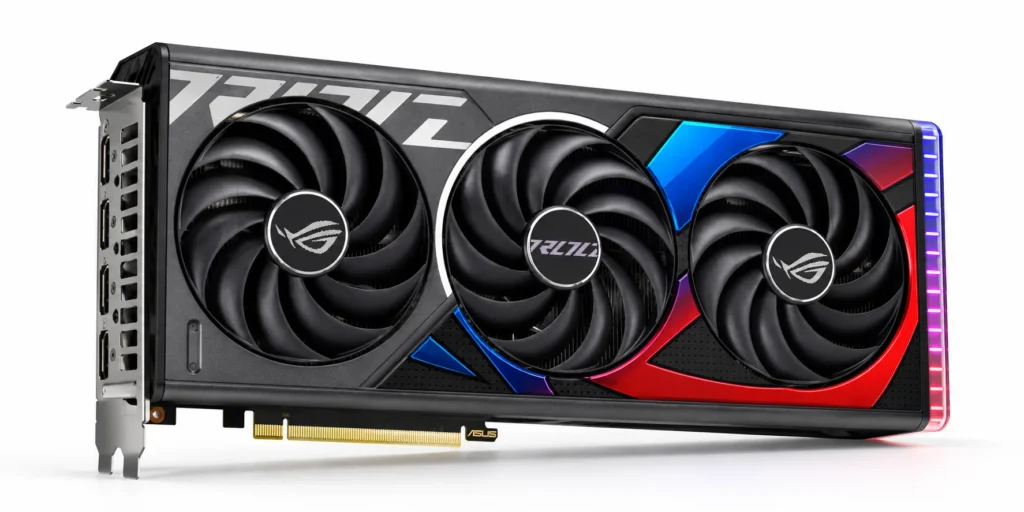
The RTX 4070 Ti Super is a high-end Nvidia graphics card built on the Ada Lovelace architecture. It replaces the RTX 4070 Ti and uses the same AD103 chip as the RTX 4080. As a result, it sits between those two cards in both performance and features.
When Did the RTX 4070 Ti Super Launch?
Nvidia announced the card at CES on January 8, 2024, and launched it on January 24, 2024. It kept the same price as the RTX 4070 Ti, and it has no Founders Edition, only partner cards.
Specifications of the RTX 4070 Ti Super
These specifications are derived from Nvidia’s official specs.
| Spec | RTX 4070 Ti Super |
|---|---|
| Compute units | 66 |
| Shaders | 8,448 |
| Ray processors | 66 |
| Tensor/AI processors | 264 |
| Base clock | 2340 MHz |
| Boost clock | 2610 MHz |
| Memory clock | 1313 MHz |
| Memory type | GDDR6X |
| VRAM | 16 GB |
| Memory speed | 21 Gbps |
| Memory bandwidth | 672 GB/s |
| Memory bus | 256-bit |
| PCIe interface | PCIe 4.0 x16 |
| TGP | 285W |
| Required power supply | 700W |
| Power connector | 1 x 16-pin |
| Slot width | Triple-slot |
What Are the Features of the RTX 4070 Ti Super?
Five features matter most: the Ada Lovelace design, 16GB of VRAM, DLSS, the core counts, and Nvidia Reflex. Together, they explain what you get for the money.
1. NVIDIA Ada Lovelace Architecture
Ada Lovelace is Nvidia’s RTX 40 series architecture. This card uses the AD103 chip from the RTX 4080 instead of the smaller AD104 in the 4070 Ti. That is why it handles 4K better than its name suggests.
What the architecture brings:
- Fourth-generation Tensor cores for DLSS 3 features, plus third-generation RT cores
- Solid efficiency: GamersNexus measured about 296W on an ASUS TUF model, 10 to 25W below an RX 7900 XT
2. 16GB VRAM
The card carries 16GB of GDDR6X, up from 12GB on the 4070 Ti, on a wider 256-bit bus. More memory reduces stutter with heavy textures and high resolutions. GamersNexus also found 10 to 11% higher 4K results than the 4070 Ti.
Why the extra memory matters:
- Bandwidth jumps from 504.2 to 672 GB/s
- 4K textures and ray tracing use more VRAM
Not sure how much memory you need? My guide on how much VRAM you need for gaming breaks it down by resolution.
3. DLSS 3.5 and Frame Generation
DLSS 3.5 pairs AI upscaling and frame generation with ray reconstruction, which cleans up ray-traced lighting. Every RTX 40 card supports it. Gamingtrend found it often turns good frame rates into great ones.
What you get:
- Super Resolution upscales lower-resolution frames, and Frame Generation adds AI-made frames
- Issue: Gamingtrend still saw occasional UI flickers
Quick news: DLSS 5 is coming to RTX 40
Nvidia says it plans to bring DLSS 5 to RTX 40 cards after it tunes performance on the RTX 50 series, Wccftech reports. However, Nvidia has not set a date, and DLSS 5 currently runs only on RTX 50 GPUs. So it adds long-term value.
4. Tensor and CUDA Cores
The card packs good Tensor cores, roughly 10% more of each than the 4070 Ti. CUDA cores handle general graphics work, while Tensor cores run the AI behind DLSS.
Best for: DLSS gaming and CUDA creative apps, where reviewers found it far ahead of the RX 7900 XT.
5. NVIDIA Reflex
Nvidia Reflex cuts system latency by tightening the timing between your CPU and GPU, so your inputs reach the screen faster. It helps most in fast shooters, and only games with Reflex support benefit.
Best for: competitive play in titles such as Valorant, Fortnite, and Apex Legends.
Problem: it cannot fix network lag or a slow CPU.
Gaming Performance of the RTX 4070 Ti Super
This card handles 1080p easily, runs 1440p at high frame rates, and averages about 70 FPS at 4K without ray tracing. These benchmarks are verified from TechRadar’s tests.
1080p
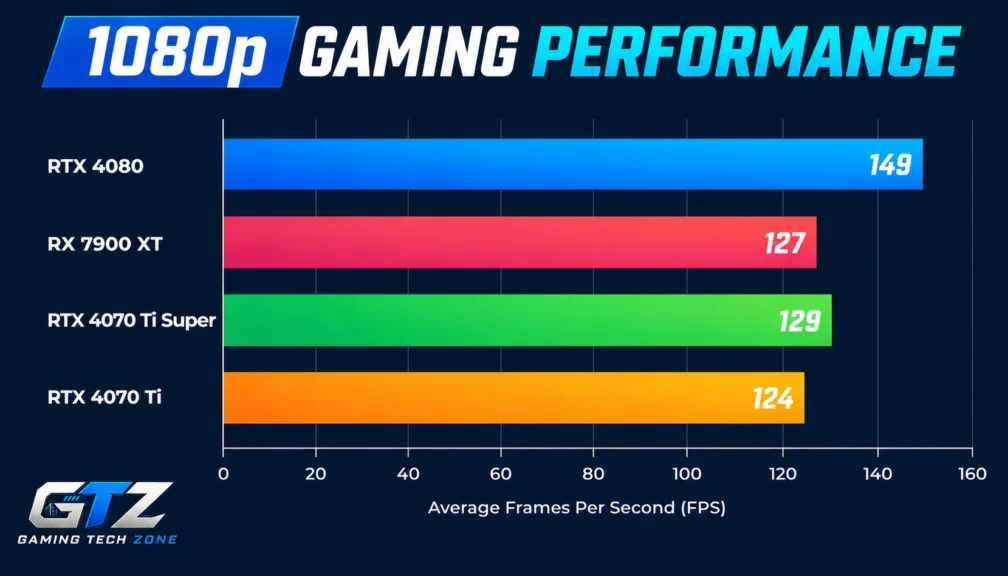
At 1080p, this card is overkill for most players. It gives around 253 FPS in Resident Evil 4, and the lead over the 4070 Ti shrank to about 5%, since extra memory matters less at lower resolutions.
Ideal for: 240Hz-plus esports monitors and heavy ray tracing.
1440p
1440p is the sweet spot. I saw a review where it was mentioned giving 172 FPS in Resident Evil 4 and 228 FPS in F1 22 in rasterized tests.
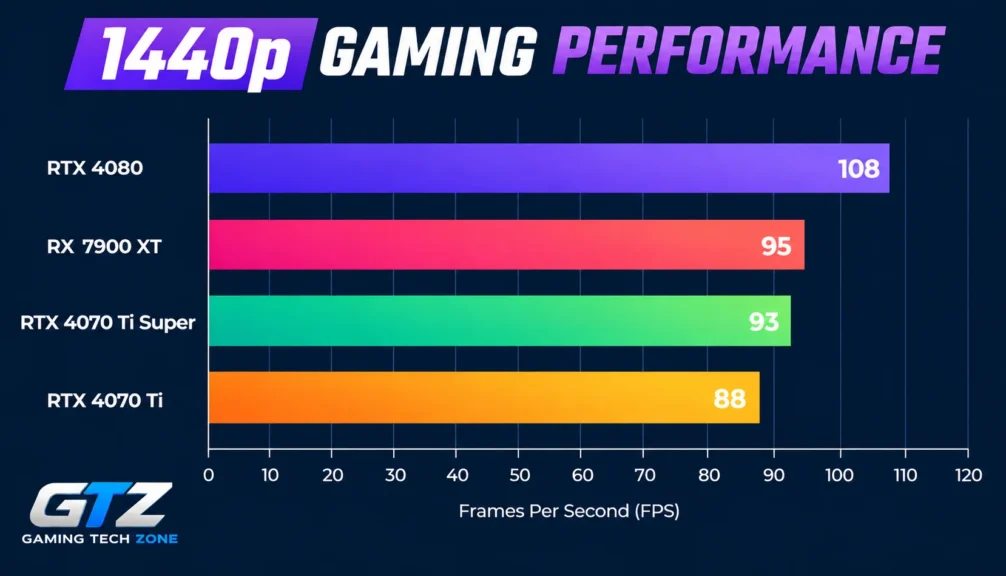
What to expect:
- Ray tracing: 96 FPS in Dying Light 2 with quality upscaling
4K
4K works well without ray tracing. TechRadar measured about 70 FPS on average, and GamersNexus logged 87 FPS in Resident Evil 4 and 137 FPS in F1 22. Native ray tracing is harder, though.
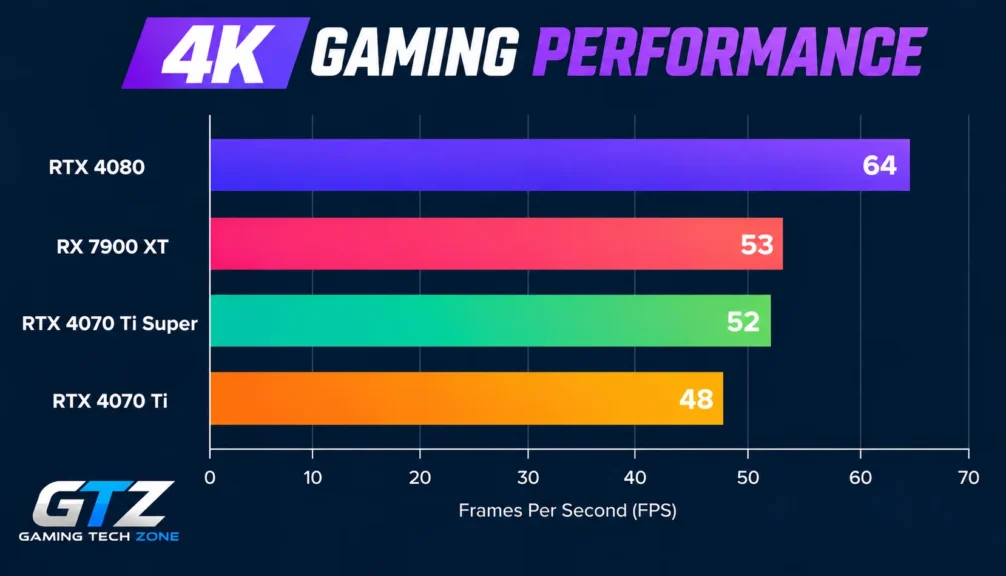
What to expect:
- Starfield: 62 FPS, GTA V: 140 FPS, and Rainbow Six Siege: 184 FPS
- Native ray tracing: about 32 FPS in TechRadar’s tests, with lows below 24 FPS
- Real example: Starfield at 62 FPS suits a 60Hz TV, while a 120Hz screen needs DLSS
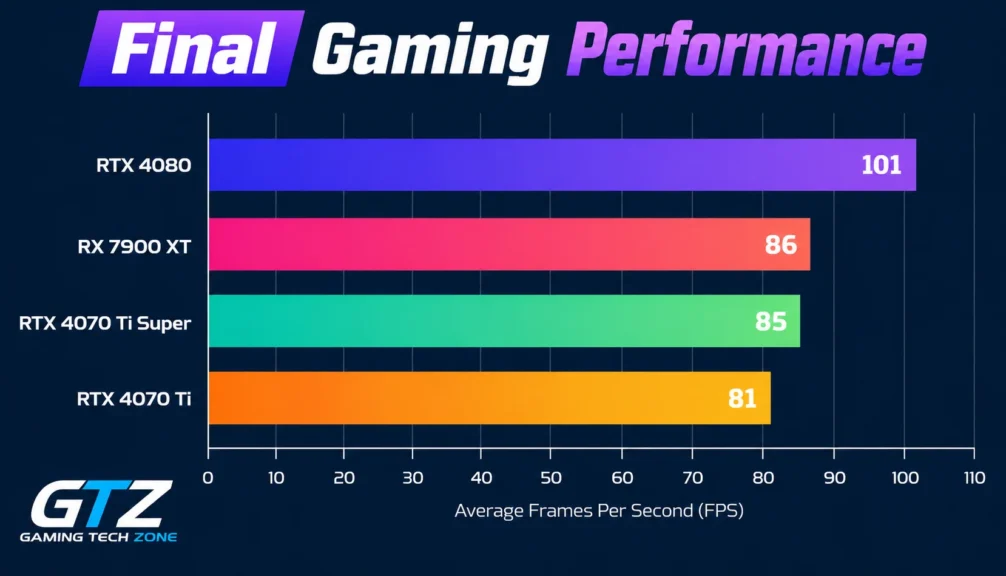
Overall Gaming Comparison
Overall, the card beats the 4070 Ti by about 5% to 11% and trades blows with the RX 7900 XT. The table shows how the gaps change with resolution.
Latest Gaming Benchmarks
| Games | FPS | Usage | Temp |
|---|---|---|---|
| 007 First Light | ~60 | ~65 | ~61 |
| Resident Evil Requiem | ~95 | ~99 | ~72 |
| God of War Ragnarok | ~150 | ~90 | ~70 |
| Ghost of Tsushima | ~120 | ~95 | ~78 |
| Assassin’s Creed Mirage | ~140 | ~99 | ~79 |
These games are played with 1440p settings with no performance mode enabled.
These benchmarks are derived from Mark PC’s YouTube channel.
What Is the Price of the RTX 4070 Ti Super?
Nvidia set the launch price at $799, the same as the RTX 4070 Ti. In 2026, however, street prices run higher.
Note: Prices can differ from region to region and country-wise, so please check the prices yourself before making the decision.
Comparison to The Competitors
The RTX 4070 Ti Super faces three real rivals: the RTX 4080, the newer RTX 5070 Ti, and AMD’s RX 7900 XT. The winner depends on price, resolution, and ray tracing.
RTX 4070 Ti Super vs 4080
The RTX 4080 wins overall, but the gap is small. Synthetic testing put the 4070 Ti Super about 13% behind, which works out to roughly 8 to 10 FPS at a 70 FPS 4K average. That FPS figure is my own math, not a direct benchmark.
Best for: buyers who want near-4080 speed for less.
Weighing the 4080 family? My RTX 4080 vs 4080 Super comparison shows how those two differ.
RTX 5070 Ti vs 4070 Ti Super
The RTX 5070 Ti is the better card when prices are close. Reviews put it roughly 9% to 16% faster, and it adds GDDR7 memory, more bandwidth, and multi-frame generation. Nvidia launched it at $749, which is $50 less.
Key differences:
- Memory: 16GB GDDR7
- Features: DLSS 5 arrives on RTX 50 first, and Multi Frame Generation is exclusive to that series
Important note: one tracker showed $1,199.99 for the 5070 Ti on September 26, 2026, so the gap can vanish
RX 7900 XT vs 4070 Ti Super
This matchup is close in standard gaming and one-sided in ray tracing. TechRadar found the RX 7900 XT about 3.5% ahead at 1440p and roughly even at 4K, while the Nvidia card handles ray tracing better.
What the tests show:
- Standard gaming: near ties at 1080p in two games, and the 7900 XT led by 9% to 12% in three 4K games
- Ray tracing: the 4070 Ti Super led by 70% or more in native Cyberpunk 2077 at RT Ultra and by 35% at RT Medium
My take: A few FPS in standard gaming matters less to me than ray tracing, CUDA, and DLSS. However, if you never enable ray tracing, the 7900 XT deserves a fair look.
Who Should Buy the RTX 4070 Ti Super?
Buy the RTX 4070 Ti Super if you want strong 1440p performance, capable 4K, and 16GB of VRAM, and you can find it near $799. Skip it if you play only at 1080p or if a new RTX 5070 Ti costs about the same.
Best for:
- Upgraders from an RTX 3070 or older: GamersNexus measured 79% to 86% gains over the 3070 at 4K
- 1440p high-refresh players and entry-level 4K gamers
Think twice if:
- You only play at 1080p: the RTX 4070 Super reached 82% of its speed for 75% of the price in one GamersNexus test
- You own an RTX 3080: the jump is smaller than from a 3070, so VRAM and Frame Generation are the main reasons to switch
What I Think About the RTX 4070 Ti Super?
In my RTX 4070 Ti Super review, the card comes out strong with a few clear weaknesses.
What I Like
- 16 GB VRAM (more than the standard 4070 Ti)
- Good price to performance
- Upcoming DLSS 5
What I Don’t Like
- The TGP matches the 4070 Ti at 285W, which suggests Nvidia left performance on the table.
- It also trails the RX 7900 XT in standard gaming at 1440p.
Pros/Cons
| Pros | Cons |
|---|---|
| 16GB VRAM on a 256-bit bus | Same 285W TGP as the 4070 Ti |
| Near-4080 performance | Slower than the 7900 XT without ray tracing |
| Strong ray tracing and DLSS | – |
| CUDA strength for creators | – |
How Many Variants Are There of the RTX 4070 Ti Super?
Nvidia made no Founders Edition, so every RTX 4070 Ti Super is a partner card. Tom’s Hardware listed ASUS, Gigabyte, MSI, PNY, Zotac, and Inno3D at launch, and each brand sells several models.
| Brand | Known lines | Notes |
|---|---|---|
| ASUS | ROG Strix, TUF Gaming, ProArt, Prime | TUF OC lists a 2,670 MHz boost; some BTF models need a compatible motherboard |
| MSI | Ventus 3X, Expert, Shadow 3X OC | Triple-fan designs |
| Gigabyte | Windforce, Gaming OC, Eagle OC | Gaming OC lists a 2,655 MHz boost |
| Zotac and PNY | Trinity, Verto | Value-focused lines |
Check before you buy:
- Card length, since compact dual-fan versions exist alongside huge triple-slot ones
- Noise: Gamingtrend found its ASUS triple-fan sample loud in performance mode
- Factory overclocks add only about 2% to 3% to the boost clock, so avoid paying much extra
Public Opinions on the RTX 4070 Ti Super
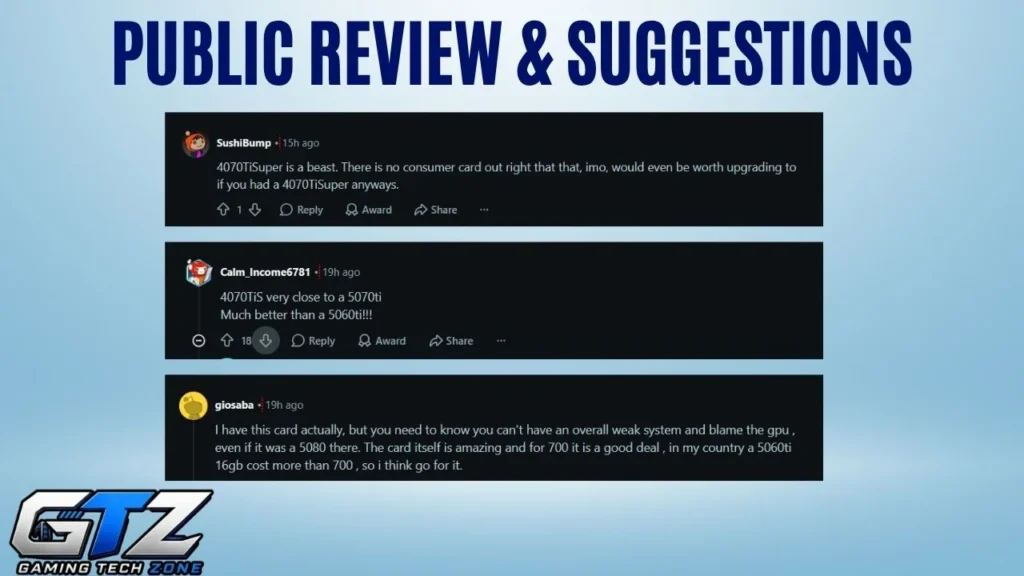
While researching, I read buyer opinions on Reddit and Quora. Most people called it a good deal, and some even said “beast“. A few said it beats the RTX 5060 Ti. Many also urged pairing it with equal parts, without cheaping out on the CPU or RAM.
Reality check: That is community opinion, so I weighed it against benchmarks. Both views can be true: it is a small step over the 4070 Ti, yet a strong choice for upgraders.
What Components to Use With the RTX 4070 Ti Super
This card performs best when the rest of your PC keeps up. Here is the pairing I recommend. For a deeper walkthrough, read my guide on how to choose PC parts.
| Part | My pick | Why |
|---|---|---|
| CPU | Ryzen 7 7800X3D at minimum; Ryzen 7 9800X3D for full performance | Avoids bottlenecks at high refresh rates |
| RAM | 32GB DDR5 | See DDR4 vs DDR5 for gaming |
| SSD | 2TB M.2 PCIe 5.0 | Fast loads, though the card uses PCIe 4.0; see PCIe 4.0 vs 5.0 |
| PSU | 700W to 750W | Nvidia lists 700W; 750W adds headroom. |
| Cooler | 360mm AIO | Thermal headroom for X3D chips |
| Motherboard | X670E | PCIe 5.0 lanes |
Note: This is my recommendation, so verify your use case first. Then decide whether to follow it or choose something different.
Mistakes to avoid
- Buying a weak power supply.
- Skipping the case clearance check, because most versions are triple-slot.
- Overspending on the CPU at 4K, where the GPU does most of the work.
Final Insights: Should You Buy It?
My answer to the RTX 4070 Ti Super comes down to this: it is a strong 1440p card and a capable 4K card. It gives you 16GB of VRAM, useful DLSS features, and performance close to the RTX 4080 and better from 5060. However, it loses a few FPS to the RX 7900 XT.
Personally, I like it as an upgrade pick, but price decides everything. Check today’s listings, compare the alternatives, and lock in your parts list before you buy.
