


Choosing a PS5 in 2026 can get confusing fast. You see 16GB GDDR6, an NVMe SSD, and 4K/120Hz support, and then the PS5 Pro adds even more numbers, but which of those specs will actually make a difference when you play?
In this guide, I’ll explain what the CPU, GPU, RAM, storage, and cooling actually do, how the current PS5 models differ, and what you should look for when building the rest of your setup around the console.
My Quick Answer
- CPU: 8-core/16-thread custom AMD Zen 2, up to 3.5GHz
- GPU: AMD RDNA 2, 36 compute units, up to 10.28 teraflops
- Memory: 16GB GDDR6, 448GB/s shared bandwidth
- Storage: Custom NVMe SSD—825GB (launch) or 1TB (Slim), expandable
- Current lineup: PS5 (Slim), PS5 Digital Edition, PS5 Pro
What is a PS5?
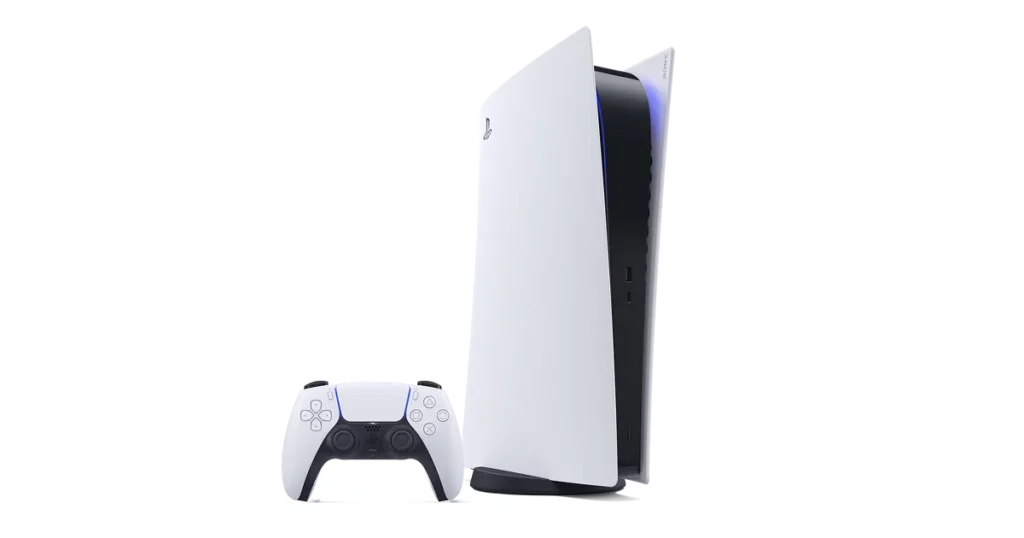
The PlayStation 5 is Sony’s ninth-generation home console, built around a custom AMD chip that puts the CPU and GPU on a single piece of silicon, backed by a purpose-built SSD instead of the mechanical hard drive the PS4 relied on.
If you’re coming from a PS4 that’s on its last legs, it’s worth checking whether it’s actually dead or just needs a fix before you retire it.
How Many Models Are There in PS5?
There are three PS5 hardware families on the market right now.
Current PS5 lineup:
- PS5 (Disc): Slimmed-down chassis with a detachable 4K Ultra HD Blu-ray drive and a 1TB SSD
- PS5 Digital Edition: Same internals, no disc drive, built for all-digital libraries
- PS5 Pro: Disc-less by default, a larger GPU, PSSR AI upscaling, and 2TB of storage
Whether the base PS5 or the Pro makes more sense for you is really its own conversation because the specification gap is almost entirely in the GPU, and it only matters if your TV and games can actually use it.
How Much Does PS5 Cost?
As of Sony’s most recent official PlayStation Blog pricing update (announced March 27, 2026, effective April 2, 2026), U.S. recommended retail prices are $649.99 for the disc edition, $599.99 for the Digital Edition, and $899.99 for the PS5 Pro.
Note: Sony has adjusted PS5 pricing more than once since 2020, so it’s worth double-checking PlayStation Direct for the current figure before you buy.
Pros/Cons
| Model | Pros | Cons |
|---|---|---|
| PS5 (Disc) | Physical/used games, resale value | Higher upfront cost than Digital |
| PS5 Digital Edition | $50 cheaper, smaller footprint | No disc drive, no used-game access |
| PS5 Pro | Strongest GPU, 2TB storage | No disc drive included, priciest option |
Whichever edition you land on, remember online multiplayer runs through PlayStation Plus, which has its own tiered pricing on top of the console which is worth factoring into your total budget.
What are the Specifications of the PS5?
Here’s the full breakdown of what’s inside a standard PS5, based on Sony’s published launch specifications:
| Component | Specification |
|---|---|
| CPU | 8-core / 16-thread custom AMD Zen 2, up to 3.5GHz (variable frequency) |
| GPU | AMD RDNA 2, 36 compute units, up to 2.23GHz, up to 10.28 TFLOPS |
| Memory | 16GB GDDR6, 448GB/s bandwidth (shared between CPU and GPU) |
| Storage | Custom NVMe SSD — 825GB (launch models) or 1TB (Slim) |
| Expandable Storage | Internal M.2 NVMe SSD slot (PCIe 4.0, 5,500MB/s+ read speed required) |
| Cooling | Large heatsink with liquid metal thermal compound, single internal fan |
| Optical Drive | 4K Ultra HD Blu-ray (detachable on Slim models) |
| Audio | Tempest 3D AudioTech |
| Video Output | Up to 4K/120Hz for gaming; up to 8K supported for select content |
| Connectivity | Wi-Fi 6, Gigabit Ethernet, Bluetooth 5.1 |
CPU
The PS5’s CPU is a custom 8-core, 16-thread AMD Zen 2 chip clocked up to 3.5GHz. That “up to” matters. Sony lists it as a variable frequency, not a fixed speed the chip holds in every game.
It handles game logic, physics, AI, and OS overhead while sharing power headroom with the GPU through AMD’s SmartShift technology.
GPU
The GPU is where the generational leap really shows. Built on AMD’s RDNA 2 architecture with 36 compute units running at up to 2.23GHz, it delivers up to 10.28 teraflops of compute power and hardware-accelerated ray tracing, which is a first for a PlayStation console.
RAM
16GB of GDDR6 memory sits between the CPU and GPU, delivering 448GB/s of shared bandwidth. Because it’s a unified pool rather than split memory, the GPU can pull the textures and geometry it needs without waiting on a separate CPU-only reserve.
Storage
Launch PS5 units shipped with a custom 825GB NVMe SSD; current Slim models ship with 1TB. Both support expansion through an internal M.2 slot, provided the drive meets Sony’s minimum sequential read speed and includes its own heatsink which is a detail that’s easy to miss when shopping for an upgrade.
If your console is acting up on the networking side instead, PS5 DNS errors are a far more common culprit than a failing drive.
Cooler
Sony’s cooling solution pairs a large custom heatsink with a liquid metal thermal interface and a single internal fan, designed to hold CPU and GPU clocks near their ceiling without heavy downclocking. It runs quieter and more evenly than the PS4 Pro’s setup, and firmware updates have continued to fine-tune fan behavior since launch.
Best Components to Use With PS5
Specs only tell half the story because what you plug into your PS5 shapes the day-to-day experience just as much. Here’s what I’d actually pair with the console.
Controller
The DualSense that ships with every PS5 covers haptic feedback and adaptive triggers well for most players, but I do recommend using custom Scuf controllers for competitive gaming.
Controller:
- Scuf Omega
- Scuf Reflex
Best For: DualSense for general play and PS5-exclusive features; SCUF Omega for ranked shooters and fighting games where paddle remapping saves real reaction time.
TV
For PS5, prioritize 4K resolution, 120Hz refresh with VRR, HDR10 support, and ALLM (Auto Low Latency Mode) over raw brightness specs.
Panel type matters too, and if you’re weighing an OLED display against a cheaper LCD/IPS panel, our OLED vs IPS panel guide breaks down where each holds up for gaming specifically.
Chair
Look for adjustable lumbar support, height, and armrests, plus breathable fabric or perforated PU leather if you play long sessions. A chair that keeps your eye level with the screen matters more for comfort than any gaming-branded extras.
Note: if you are using a TV instead of a monitor, then you don’t need to worry about the chair because you can play games while lying or sitting on your bed.
Headsets
Use something which is made for better gaming experience.
I recommend:
Microphone
If you’re streaming or recording commentary alongside PS5 gameplay, a dedicated USB mic beats a headset boom mic every time. The Fifine AM8 is a budget USB/XLR dynamic mic with a cardioid pickup pattern, a physical mute button, and RGB accents.
Should You Buy a PS5 in 2026?
The core PS5 specs that contain the Zen 2 CPU, RDNA 2 GPU, and custom SSD haven’t changed since 2020, and they’ve aged well because Sony built real headroom into the design.
What has changed is the price, the lineup (Slim and Pro now sit alongside the original), and the accessory ecosystem around it. If it’s your first PS5, the standard Slim edition covers nearly everyone; save the Pro for a strong 4K/120Hz TV and games that actually use its extra GPU muscle.
Either way, pair it with a controller, headset, and mic that match how you actually play, not just what looks good in a bundle.
