
The Gaming Brief:
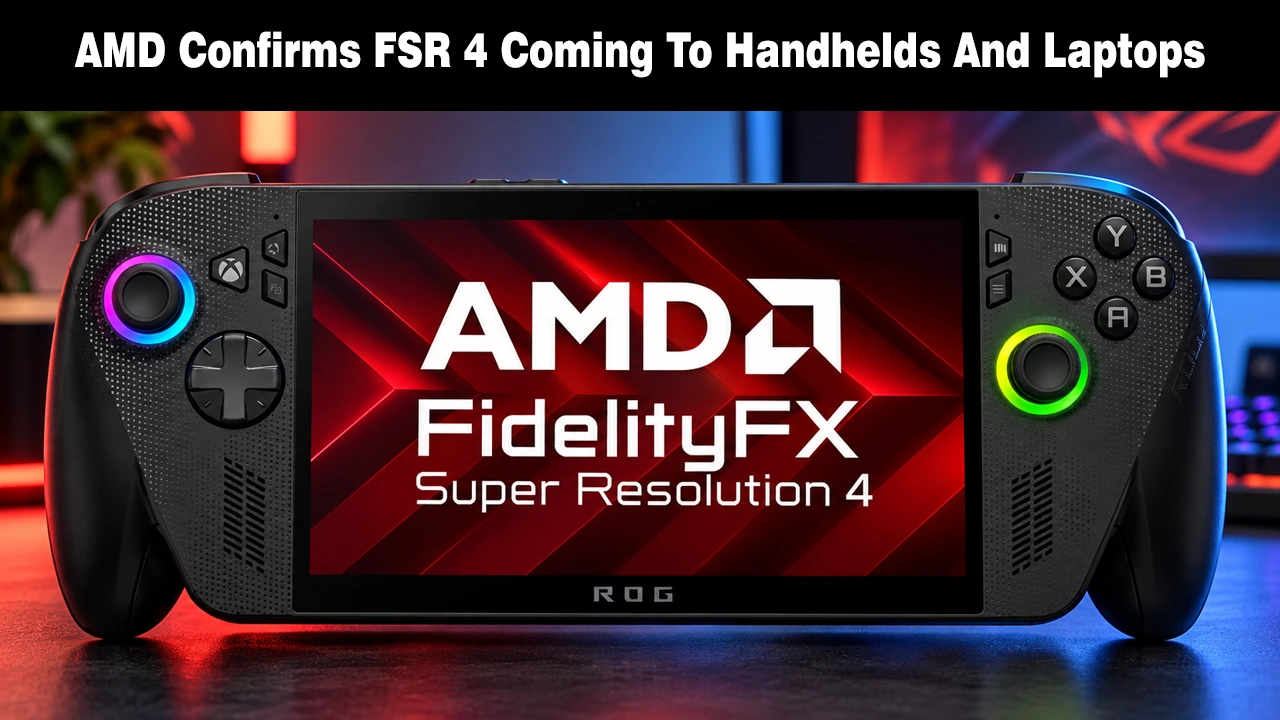
- AMD’s Jack Huynh told Korea’s The Elec that FSR 4 will reach APUs, gaming laptops, and handhelds by the end of this year
- AMD built a new lightweight FSR 4 model tailored for APUs, aimed at strong image quality and low latency
- The plan covers both existing APUs and new product lines
- Ryzen handhelds like the ROG Xbox Ally X and Legion Go currently have official access only to FSR 3
Ryzen handheld owners just got a deadline for machine-learning upscaling.
AMD’s Jack Huynh, senior vice president and general manager of Computing and Graphics, told South Korean outlet The Elec that FSR 4 will expand beyond Radeon RX 9000 and RX 7000 graphics cards to APUs, gaming laptops and handheld devices before 2026 ends.
AMD says the plan covers existing APUs, not only new chips, though no model list has been published.
Jack Huynh’s Lightweight FSR 4 Model Is Built for APU Limits
Huynh said AMD “newly developed a dedicated model of FSR 4 that is lightweight and tailored for APU environments,” focusing on game graphics and low latency, per Windows Central’s translation of The Elec.
Wccftech explains why that matters: APUs lack the raw power of discrete Radeon GPUs like the RX 9000 series, and even the RDNA 3.5-based Radeon 8060S and 8050S iGPUs still work with the INT8 data type, unlike RDNA 4.
Huynh described the rollout as responding in two directions: existing APUs and new product lines.
ROG Xbox Ally X and Legion Go Owners Are Next in Line
Windows Central notes that Ryzen handhelds, including the ROG Xbox Ally X and Lenovo Legion Go, have so far had official access only to FSR 3.
Enthusiasts have run a leaked FSR 4 build on APUs suited to FSR 3 and 3.5, trading FSR 3’s hand-tuned upscaling for machine learning, but with performance drawbacks.
AMD teased a lightweight alternative earlier this year when it unveiled FSR 4.1 for Radeon RX 7000 GPUs, saying it needed more time.
Confirmation arrived about four months later. Neither report names which existing APUs will get support.
Intel’s Arc G3 Handhelds Raised the Pressure on Ryzen
Windows Central’s Cale Hunt tried the MSI Claw 8 EX AI+, Acer Predator Atlas 8 and OneXPlayer 3 at Computex 2026, all built on Intel’s Arc G3 and G3 Extreme chips.
While Intel highlights XeSS 3 upscaling and claims strong performance over AMD’s Ryzen Z2 Extreme, Hunt notes these Intel devices carry a higher price tag, leaving room for FSR 4 to keep Ryzen competitive.
The delay has precedent. Wccftech reports AMD took over a year after the Radeon RX 9000 launch to bring FSR 4 to RDNA 3-based RX 7000 cards, with RX 6000 support planned for early 2027.
Source: AMD’s superior FSR 4 upscaling is coming to the full product stack before 2027
